


Odoo vs SAP: Which ERP Scales Your SME Better?
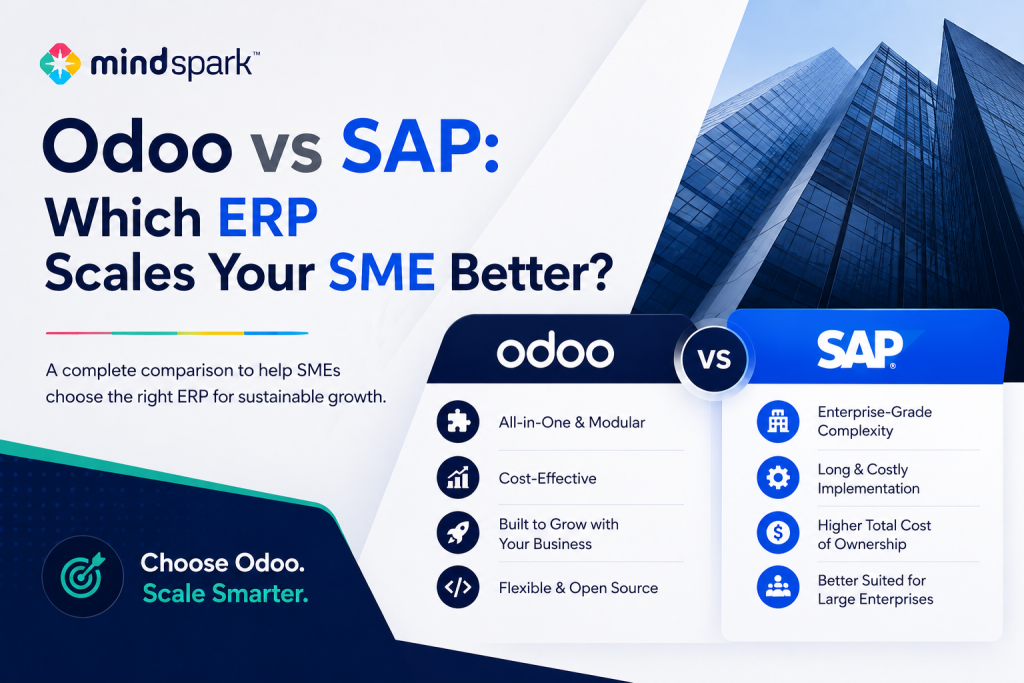
The SME ERP Challenge As businesses grow, managing operations through disconnected spreadsheets and siloed software creates measurable inefficiencies. Finance, inventory, sales, procurement, manufacturing, and CRM often operate in isolation, limiting visibility and slowing growth. Enterprise Resource Planning (ERP) software solves this by unifying every business function on a single platform. Among today’s leading ERP choices, Odoo and SAP stand out, but they serve very different audiences. Key Question for SMEs Between Odoo and SAP, which platform delivers the right balance of power, flexibility, and cost for a growing business, without the enterprise overhead? This guide answers that question with data, comparisons, and real-world context. What Is ERP Software? Enterprise Resource Planning (ERP) software is a centralized platform that integrates multiple business processes into a single connected system, eliminating data silos and enabling real-time decision-making across your organization. Core ERP Modules at a Glance ERP Module Business Function Covered Accounting & Finance Ledgers, invoicing, tax compliance, financial reporting Inventory Management Stock tracking, warehousing, reorder automation Sales Management Quotations, orders, revenue tracking Procurement Purchase orders, vendor management, approvals CRM Lead tracking, pipeline management, customer retention Human Resources Payroll, attendance, recruitment, appraisals Manufacturing Production planning, BOMs, quality control Project Management Tasks, timelines, resource allocation Reporting & Analytics KPI dashboards, custom reports, forecasting Understanding Odoo ERP Odoo is a modern, modular ERP platform designed for businesses that need powerful capabilities without enterprise-level complexity or cost. Its open-source foundation and app-store model make it uniquely flexible. Businesses start with the modules they need today and add more as they grow, making Odoo a platform that scales with the business rather than forcing early over-investment. Odoo: Full Module & Benefit Overview Odoo Module What It Does SME Advantage CRM Lead & pipeline management Faster sales cycles Sales Management Quotes, orders & invoicing Reduced manual entry Inventory Management Stock, WMS & logistics Real-time stock visibility Accounting Full financial suite Built-in tax compliance Manufacturing MRP, BOMs, work orders Production efficiency Human Resources Payroll, leaves & appraisals Streamlined HR ops eCommerce Online store integration Unified B2C/B2B sales Project Management Tasks, timelines, billing On-time delivery Marketing Automation Email & campaign tools Lower CAC Helpdesk Ticket & SLA management Better CX scores Understanding SAP ERP SAP is the world’s most established ERP provider, trusted by large enterprises across industries. For SMEs, SAP Business One is the most relevant offering, purpose-built for smaller organizations but carrying SAP’s enterprise DNA. SAP: Module & Positioning Overview SAP Module What It Does Best Suited For Financial Management Multi-currency, compliance reporting Regulated industries Supply Chain Management End-to-end supply visibility Complex logistics Manufacturing Advanced production scheduling High-volume manufacturing Procurement Strategic sourcing & vendor mgmt Large procurement teams Sales & CRM Enterprise sales workflows Large sales organizations Business Intelligence Advanced analytics & dashboards Data-heavy enterprises Compliance Management Audit trails, GDPR, SOX Compliance-driven sectors Advanced Reporting Custom enterprise reports C-suite reporting needs Odoo vs SAP: Complete Feature Comparison The table below compares Odoo and SAP across all major decision dimensions and highlights how Mindspark Technologies’ expert implementation elevates Odoo’s value proposition for SMEs. Feature Odoo SAP Total Cost of Ownership Low–Medium High Customization Flexibility Very High Moderate Implementation Speed 4–12 weeks 6–18 months User Friendliness High Moderate SME Fit Excellent Good Enterprise Scalability High Very High Open Source Yes No Module Expansion On-demand License-based Cloud Deployment Yes Yes Analytics & BI Good Excellent Learning Curve Low High Industry Modules 40+ modules Industry packs Odoo vs SAP: Total Cost of Ownership Cost is the most decisive factor for SMEs. Understanding the full investment picture, beyond just licensing is essential for making a smart ERP decision. Cost Component Breakdown Cost Component Odoo SAP Licensing / Subscription Low — per-user/module High — per-module enterprise Implementation Faster = lower cost Longer = higher cost Customization Cost-efficient (open-source) Expensive (proprietary) Training Minimal learning curve Extensive training required Maintenance Streamlined updates High maintenance overhead Integration Flexible, lower cost Costly integration layer Total TCO Low to Medium Medium to High Mindspark Advantage on Cost Mindspark Technologies delivers Odoo implementations that maximize ROI by scoping only the modules your business truly needs, eliminating over-investment from day one. Our phased delivery model spreads implementation costs across growth milestones, making enterprise-grade ERP accessible at SME budgets. Scalability: Can Odoo Keep Up as You Grow? A common misconception is that only enterprise-grade platforms can scale effectively. Modern Odoo implementations — when architected correctly — support thousands of users and highly complex operations. Scalability Capability Comparison Scalability Dimension Odoo SAP Multi-Company Management Native support Supported Multi-Location / Warehouse Yes Yes User Volume 1,000+ users Enterprise scale Transaction Volume High Very High Module Expansion On-demand License-based Global Operations Multi-currency/language Full global suite Cloud / On-premise Both Both Custom Workflow Growth Easy expansion Complex changes Implementation: What to Expect Implementation quality determines ERP success more than software selection. A well-executed Odoo deployment will outperform a poorly executed SAP project every time. Implementation Comparison Table Implementation Factor Odoo SAP Average Timeline 4–16 weeks 6–18+ months Project Risk Lower Higher User Adoption Speed Fast Slower Training Requirements Low–Moderate Extensive Consulting Dependency Moderate High Customization Complexity Low–Medium Medium–High Go-Live Risk Lower Higher Mindspark Implementation Methodology Discovery & Process Mapping → Solution Architecture → Phased Build → UAT & Training → Go-Live → Ongoing Support Our proven 6-stage implementation process reduces go-live risk, accelerates adoption, and ensures your team is confident from day one. Real-World Applications by Industry Industry Fit: Odoo vs SAP Industry Odoo Fit SAP Fit Mindspark Recommendation Retail & eCommerce Excellent Good Odoo — fast deployment, POS + eCommerce unified Manufacturing Very Good Excellent Odoo for SME MFG; SAP for complex enterprise Services & Projects Excellent Good Odoo — project billing + CRM native integration Distribution Excellent Good Odoo — WMS + inventory + logistics in one Healthcare Good Very Good SAP for compliance-heavy; Odoo for clinics/SMEs Construction Very Good Good Odoo — project mgmt + procurement + HR ERP Selection Pitfalls to Avoid Common Mistake How Mindspark Prevents It Choosing by brand name, not fit Needs analysis first — we map